Utility trenching in San Bernardino
Verdemont Excavation refers trenching jobs from a short solar run to a long service to a barn. Here is what goes into one.
How a utility trench is dug
Every trench starts with a DigAlert ticket at least two working days before digging, so the gas company, Southern California Edison, the water district and cable providers can mark their lines. Near a marked line the last stretch is dug by hand or with a vacuum excavator.
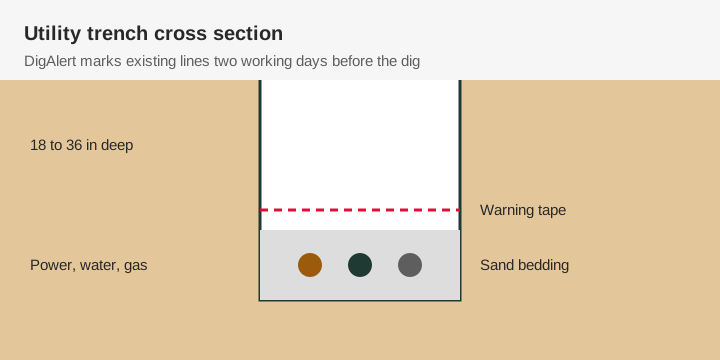
Depth depends on what goes in it. Electrical conduit, water and gas each have code minimums, and a shared trench needs separation between them. The pipe or conduit sits on sand bedding, gets inspected before backfill, and a warning tape goes in above it so the next person digging finds the tape before the line.
What trenching costs
| Job | Typical range | What moves the price |
|---|---|---|
| Machine and operator, hourly | $185 to $325/hr | Machine size, attachments, how hard the ground digs |
| Mobilization, equipment in and out | $300 to $850 | Distance from the yard, mountain roads, trailer moves |
| Utility trench, per linear foot | $25 to $70 | Depth, cobble, hand digging near lines, surface patch |
| Spoil export, per truckload | $175 to $400 | Haul distance, clean fill or mixed, loading access |
Every row comes from the full cost guide.
What drives the price per foot
Ground is first. Sandy valley soil trenches quickly, typically $25 to $45 a foot. Cobble near the foothills, from Verdemont to Alta Loma, or decomposed granite on the mountain can push it to $70 a foot. Surface is second: lawn and dirt are cheap to restore, concrete and asphalt need saw cutting and patching. Length matters less than people think, because mobilization is spread over every foot.
- 1
DigAlert ticket
Filed two working days ahead, existing lines marked.
- 2
Saw cut and dig
Hardscape cut cleanly, trench dug to depth.
- 3
Bed and lay
Sand bedding, conduit or pipe laid to spec.
- 4
Inspection
City or utility inspects before cover.
- 5
Backfill and restore
Compacted backfill, tape, and the surface put back.
Trenching questions
How much does trenching cost per foot in San Bernardino?
Typically $25 to $70 a foot. Sandy soil and open dirt sit at the low end; cobble, rock and concrete to cut and patch sit at the high end.
How deep does an electrical trench need to be?
It depends on the conduit type and what it runs under. The electrical code sets the minimum, and the inspector checks it before backfill. The contractor digs to the depth on your permit.
Do I need to call DigAlert myself?
The contractor files the ticket. California requires one at least two working days before any digging, even in your own backyard.
Can power and water share one trench?
Often yes, with the separation code requires. Sharing a trench is one of the easiest ways to save money on an ADU or a barn run.
Towns where this comes up most: Yucaipa, Rancho Cucamonga, Devore, Fontana.
Get a trench priced
The address, the job and a photo or two. One licensed contractor calls within one business day.